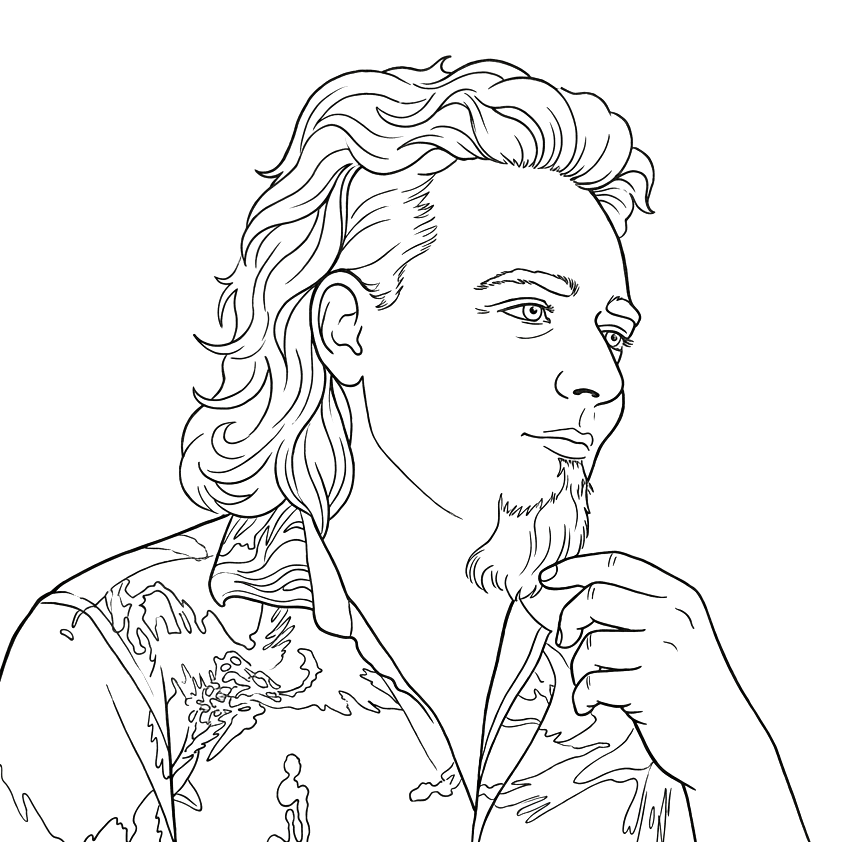
Preface
Palmer Luckey’s argument is not merely that he was wrongly fired. It is something stranger and harder to ignore: that an entirely fabricated version of reality replaced the actual one, that the institution responsible was his own employer, and that the correction mechanisms that should have fixed this — journalism, corporate accountability, public memory — are structurally broken.
The argument depends on a single distinction. Fabrication is inventing something that didn't happen. Selection is choosing which true things to say. Luckey insists the difference is fundamental.
The Disproportion
Start with what Luckey says actually happened. In late September 2016, he donated $9,000 to a pro-Trump nonprofit called Nimble America. The organization ran one billboard — a picture of Hillary Clinton with the words "Too big to jail" — in the midst of the controversy over her handling of classified material.
Now consider what Luckey says was reported — not merely implied, but printed in major outlets and treated as fact:
Palmer LuckeyShawn Ryan Show
The gap between these two realities is the foundation of everything that follows. Luckey insists on the distinction not to minimize the donation, but for a reason most people miss — to be fair to the people who were angry at him. They weren't angry about a billboard. They were angry about something that never happened.
Palmer LuckeyThe Logan Bartlett Show
Luckey says the public was not at fault. The journalists were. The Daily Beast implied connections to white nationalism without explicitly stating them, while Wired, Washington Post, and the New York Times published original multi-paragraph articles treating unverified Twitter commentary as sourced fact. The infamous "developer boycott" amounted to three companies — a paper trading card maker that later said it was joking, and two solo developers who had never released games and weren't even Oculus partners. Every actual Oculus partner stayed.
If you accept this premise — that the gap between reality and reporting was as vast as Luckey claims — then what Facebook did next becomes much harder to defend.
The Trap
Luckey drafted a statement. It said the reports were false. It said he donated $9,000 to a group that ran a billboard. It said everyone was lying.
Palmer LuckeyShawn Ryan Show
They wrote their own statement for him instead — a forced apology. They told him he was taking a "voluntary leave of absence." In reality, they explicitly barred him from the office until after the election. They told him he could say nothing negative about Hillary Clinton and nothing positive about Donald Trump. Meanwhile, employees were printing "I'm with her" posters on the campus print shop and plastering them all over San Francisco.
The trade, as Luckey came to understand it, was supposed to work like this: you let the company handle your PR, and in exchange, they don't fire you. He accepted the trade. He stayed quiet. His silence turned the false stories into truth.
Palmer LuckeyShawn Ryan Show
Facebook's plan assumed Clinton would win. If she did, the controversy would blow over — just an eccentric billionaire who backed a fringe candidate. Luckey told them Trump was going to win. They said, "Wow, I thought you were a smart person." Trump won. They told Luckey he couldn't come back to the office. Not after the election. Not ever.
They launched an internal investigation. They dug through years of emails and communications. They interviewed dozens of employees. Luckey expected them to find something — you manage a thousand people for three years, you assume you broke a rule at some point. They found nothing. Zero policy violations. So they fired him without cause.
Palmer LuckeyTetragrammaton with Rick Rubin
A company investigated its own founder, found no wrongdoing, and fired him anyway — for a $9,000 donation to a legal political organization, in a state where political activity outside of work is legally protected. At the same time, Oculus had exceeded its internal targets — ten million users in two years instead of five — and Luckey had earned all his performance bonuses with excellent reviews.
Luckey does not argue that political firing should always be illegal. He actually believes companies should sometimes be able to fire people for their political views — he constructs a thought experiment about a Citibank executive who publicly advocates dismantling capitalism and says he'd fire that person too. His complaint is not about the act. It is about the lying.
Palmer LuckeyThe Logan Bartlett Show
The Lie That Wouldn't Die
After the firing, Facebook maintained for years that politics played no role. Their CTO, Andrew Bosworth, publicly said on multiple occasions that Luckey's termination "had nothing to do with politics" and "was not a factor in any way whatsoever". They told people privately that Luckey was fired for cause — that he'd done something "beyond the pale" that left them no choice. Jason Calacanis, one of Silicon Valley's most influential voices, celebrated the firing and spent years attacking Luckey's character and credibility.
When Senator Ted Cruz asked Mark Zuckerberg in Congress why Luckey was fired, Zuckerberg said it was "not a political matter." Luckey's read of this is more nuanced than people expect:
Palmer LuckeyShawn Ryan Show
Through subsequent litigation, Luckey says he obtained documents showing it was not Zuckerberg who orchestrated the firing. It was people much closer to Luckey himself — mid-level partisans who, he says, were "deeply partisan and highly biased against a particular outcome". He followed the evidence to its conclusion, and the conclusion was uncomfortable. This was a principal-agent problem, not a top-down conspiracy:
Palmer LuckeyMoonshots with Peter Diamandis
And then he admits he would probably make the same call:
I hate to say it, but that's probably the decision I would make in my company.
Palmer LuckeyMoonshots with Peter Diamandis
This is not magnanimity performed for public consumption. Luckey put every liquid dollar he had into Meta stock the day they announced the name change, calling Zuckerberg "the number one VR fan in the world". When a journalist from Tablet Magazine emailed Meta saying he was going to report that Luckey's firing was political, he expected a response from a PR flunky. Instead, Zuckerberg himself replied: "Palmer's a great American, Anduril's a great company, and I'm really glad that they're doing things to protect our national security." That reply kicked off the reconciliation that led to their military partnership. Bosworth later apologized publicly, and Zuckerberg said he enjoyed working with Luckey and that what happened was unfortunate.
The system failed. The people inside the system acted on partisan bias. The people above them trusted the system. Nobody at the top had to be evil for an evil outcome to occur. Luckey didn't arrive at this conclusion generously. He arrived at it through documents.
But the institutional lies had consequences that outlasted anyone's intentions. Facebook's failure to correct false stories for nearly a year cemented them as accepted truth. Wikipedia's policy of trusting third-party media over primary sources created a self-reinforcing cycle. Ars Technica refused to correct their article for six years, then quietly deleted it without retraction. In a separate case, a company fabricated IP theft claims against him. Hundreds of articles covered the lawsuit. He fought to a unanimous jury verdict — his second. A dozen journalists were in the courtroom. Luckey says not a single article was written about the win.
And now the false narrative has migrated into a medium that may be permanent. Luckey asked the Meta Ray-Bans AI when he was fired. It replied that he was "fired on March 29th, 2017 after being found guilty of stealing intellectual property in a trade secret lawsuit." He won on all trade secret charges. The judge threw out all damages. A journalist wrote something demonstrably false, and AI systems trained on that reporting now repeat it as fact. Even if the original articles were corrected tomorrow, the models have already been trained on a decade of false reporting.
Palmer LuckeyLulu Cheng Meservey
Luckey does not blame the public for believing the stories. He blames the people who created them.
Palmer LuckeyThe Logan Bartlett Show
Years later, in late 2024, Bosworth publicly reversed himself. He posted that the things said about Luckey were not true, that he had been misinformed by people no longer with the company, and he said the words "I'm sorry". Luckey accepted it as a kind of victory — and noted the limitation:
Palmer LuckeyShawn Ryan Show
Subscribe for the next portrait
People, from their own words.
The Cost
Oculus was not just a job. Luckey had been building VR headsets since he was fifteen. He founded the company at nineteen. By the time Facebook fired him, he had spent a decade on virtual reality — basically his entire adult life and most of his teenage life. Every friend, every technology, every piece of intellectual work he had produced since childhood belonged to the company.
Palmer LuckeyShawn Ryan Show
The last thing he worked on before being fired was what became the Oculus Quest — internally codenamed Santa Cruz, a standalone headset that fulfilled his original vision for the company. It shipped under someone else's name. That someone else was Andrew Bosworth — the man who had publicly called Trump supporters "shitty human beings" and was promoted to lead Oculus after Luckey's departure.
At his lowest, people were calling Luckey a one-hit wonder, a loser, damaged goods. One person stood up. Chris Dycus, Oculus employee number one, posted internally at Facebook: "This is fucked up. I can't believe you guys did this. You guys are a bunch of lying assholes. The way you treated Palmer is just obscene. And I'm outta here."
He became the first employee of Anduril.
After the Facebook acquisition, the New York Stock Exchange had emailed Oculus inviting Luckey to ring the opening bell. Another executive intercepted the email, told NYSE that Luckey couldn't make it, and went himself — without ever telling Luckey the invitation existed. Luckey found out seven years later, when the email surfaced in unrelated litigation. The hostility predated the donation. The political controversy gave it permission to act.
What It Produced
Politics was not the center of his life before the firing. He describes himself as libertarian-minded but politically inactive, having donated $40 to Gary Johnson. He attended a Hillary Clinton fundraiser in Silicon Valley. He was considering supporting an immigration reform group. He had written Trump a letter at fifteen encouraging him to run for president. He had opinions. But he was a VR guy who happened to have politics, not a political person who happened to build headsets. The firing reversed the order.
Palmer LuckeyCore Memory
He knows his recovery was not universally available. He had hundreds of millions of dollars, a network of co-founders ready to build something, and a pre-existing interest in defense technology. He explicitly acknowledges that his strategies can't be modeled by people without his resources. He was not a serial entrepreneur by choice. He would have stayed at Oculus his entire life. Getting fired forced a choice he might never have made voluntarily. The moment it happened, he called Trae Stephens and Brian Schimpf and told them it was time to build the defense company they'd been searching for as investors. That became Anduril Industries, the defense company that turned Luckey’s post-Facebook life into something larger than a comeback.
At Anduril, managers who publicly disparage employees based on political beliefs are fired — zero tolerance:
Palmer LuckeyAll-In Podcast
People tell Luckey that Anduril exists because of the firing. He has an answer for that.
Palmer LuckeyMoonshots with Peter Diamandis
The Chilling Effect
The firing also produced a warning.
In 2016, Palmer says Facebook had two Trump donors and 9,000 Clinton donors — not because the ratio of actual support was 4,500-to-1, but because public donation was understood to trigger "the Palmer Luckey experience". Luckey knows people still at Facebook who explicitly told him they saw what happened and will never make a political donation or express a political view as a result. He argues this was not accidental:
Palmer LuckeyThe Free Press
His own advice to right-wing founders, ironically, is the opposite of what he did:
Palmer LuckeyAll-In Podcast
What He Hasn't Forgiven
And then there is the part that undermines any attempt to cast Luckey as a simple victim. Asked by Bari Weiss whether he has forgiven the people who wronged him, his answer is one word. No.
I don't have to forgive and I don't have to forget, but I can present a facade as if I have.
Palmer LuckeyThe Free Press
That one event in my life, I will never forgive any of the people who are responsible.
Palmer LuckeyMoonshots with Peter Diamandis
He works with Meta now, on military contracts. The grudge is not gone. The mission is bigger. It has always been bigger. On Bloomberg in 2023, before the reconciliation, he called himself a "VR partisan" — someone who chooses not to light his enemies on fire because it would be bad for the VR industry he wants to see succeed. On the Logan Bartlett Show, he said there are many people who wronged him whom he's never gone after, "because I've done the calculus and it would be bad for the VR industry". The mission always wins. First VR, now national security.
Palmer LuckeyThe Free Press
He says he has the internal documents. He obtained them through discovery in unrelated litigation. He knows the exact sequence of events that led to his termination and says "it's horrible and it should never happen again." He has chosen not to release them. Not out of mercy.
Palmer LuckeyThe Free Press
He calls himself a propagandist. He means it — but not in the way the word usually lands. Luckey's argument is that everyone in public life is a propagandist: journalists, governments, militaries. He compares reporters who claim neutrality to football players who insist they aren't football players — "You're paid millions of dollars to make a particular team win," and they say, "No, no, we're just here to play football. I don't even think about any of that". His position is not that advocacy is corrupt. His position is that unlabeled advocacy is corrupt, and that labeling it is the more honest move. Anduril's internal media channel is literally called "Propaganda." The name is the principle.
He also draws a hard line at fabrication:
Palmer LuckeyThe Free Press
He quotes Gabe Newell as a governing principle: "Don't ever try to lie to the internet. They're too smart, they'll see right through it, and they'll never trust you again." This is the distinction at the center of his philosophy: the media invented stories about white supremacist troll farms that never existed, Facebook knew it was false and chose not to correct it, and instead denied the political nature of his firing for a decade. Luckey selects which true things to say and labels himself as an advocate while doing it. He considers the difference fundamental.
Putting It All Together
In Luckey’s telling, a fabricated media narrative — created by journalists, enabled by corporate cowardice, and sustained by broken correction mechanisms — destroyed his Oculus career, damaged his reputation, and destroyed his identity for a legal $9,000 political donation. In that account, the company that employed him knew the narrative was false, silenced him from correcting it, investigated him and found nothing, fired him anyway, then lied about the reason for nearly a decade. The people Luckey holds responsible are gone. Bosworth apologized. And still, the false version persists — in articles that were never corrected, in Wikipedia entries that trust those articles, and now in AI systems trained on a decade of false reporting.
The experience did not make him forgiving. It made him strategic.
In one moment, Luckey speaks of the Ship of Theseus — the conspirators are gone, the company is different, what is there really left to be angry at? In another, he says, he is a vengeful, bitter, cynical person who will never forgive any of the people responsible. Both are true. They are not tailored for different audiences. They exist simultaneously, and he knows they don't resolve. The feelings don't change. The behavior does. The mission always wins. First VR, now national security.