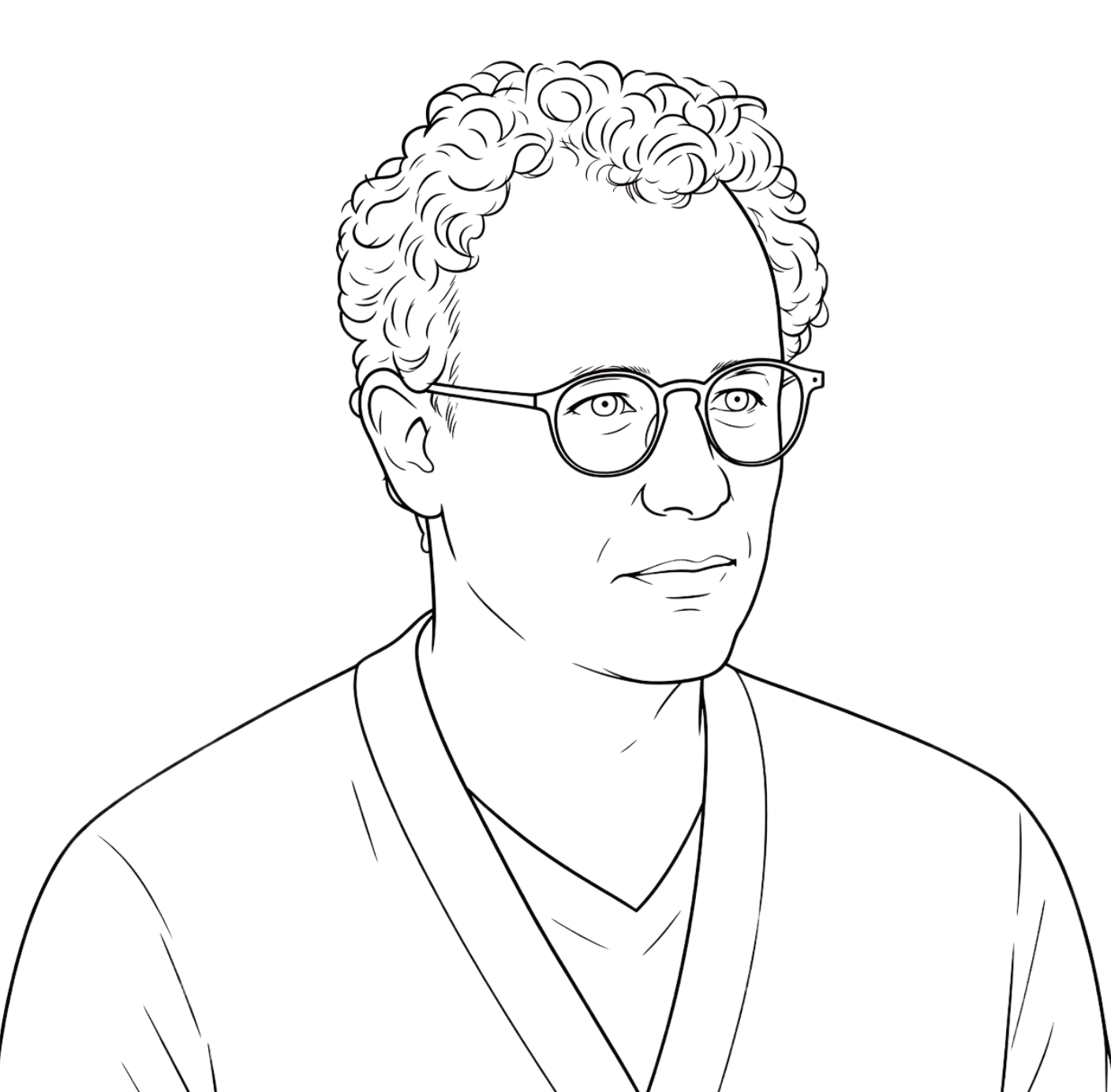
Preface
In 2006, Dario Amodei's father died. Three or four years later, the cure rate for his disease jumped from 50% to 95%.
That gap — a few years too late — pushed a would-be theoretical physicist into biology, then into AI, following a single conviction that grew sharper at every turn: the complexity of biological problems is beyond human scale, and AI is the only technology that could bridge it.
He does not talk about this often. But when people call him a doomer — when they accuse him of wanting to slow the very thing that could save millions — the anger is immediate:
Dario AmodeiAlex Kantrowitz
He also estimates a 10–25% chance that AI development substantially derails civilization. He holds both. Not because he hasn't thought hard enough to resolve the tension, but because he has thought hard enough to know it doesn't resolve.
The Exponential
He was trying to understand how proteins behave in living cells, but a single protein could be modified in dozens of ways depending on where it sat, and each modification changed what it did — an explosion of variables that multiplied faster than any human could track. He spent most of his time on the engineering of measurement rather than the science of understanding and was "starting to despair that biology was too complicated for humans to understand." Then deep learning came along. He still thinks of himself as "kind of a scientist first" — and he approaches AI the way a physicist approaches a new phenomenon: measure it, extrapolate, hold your conclusions lightly, and be honest when the data runs out.
The data, so far, has been remarkably consistent.
For ten years he has watched scaling laws hold. Give a model more data, more compute, more parameters — all three together, like a chemical reaction — and performance improves. He and his co-founders first measured these trends when training a model cost a thousand dollars. They predicted the trends would hold at a hundred million. Then a billion. Then ten billion. The predictions, he says, "seemed highly unlikely at the time." They held anyway.
Dario AmodeiDwarkesh Podcast
He is an empiricist riding an exponential curve, watching it hold, and extrapolating — while assigning roughly a 20–25% probability that it will stop. If it stops, he's fine looking foolish. If it doesn't, the implications are staggering. He does not think there is a magic threshold called "AGI" where everything changes — just a continuous curve, the way Moore's Law was a continuous curve, with the models getting more capable at everything and the revenue "adding zeros" alongside.
He predicts with 70–80% confidence that within two to four years, AI models will match Nobel Prize winners across many fields — a country of genius remote workers inside a data center, capable of any task a human can perform on a computer.
If that prediction is right — or even close to right — what you do about it is the only question that matters. Amodei's answer starts with a scene he can't shake. In the film adaptation of Carl Sagan's Contact, an international panel interviews candidates to represent humanity to alien life. One is asked: if you could ask the aliens one question, what would it be?
Dario AmodeiDRM News
Both Hands Full
He sees five categories of danger. Autonomous AI systems that are smarter than any human and may not do what their creators intend. Individuals misusing AI for bioterrorism and other catastrophic harm. Authoritarian governments weaponizing AI for repression — creating individualized propaganda, surveilling entire populations, deploying massive drone armies. Economic displacement on a scale humanity has never experienced — possibly fast GDP growth and high unemployment simultaneously. And the one he finds hardest of all: the unknown unknowns, the risks nobody has anticipated.
Dario AmodeiBloomberg Originals
He holds these dangers in one hand. In the other, he holds an equally vivid picture of what AI could do if it goes right. Curing cancer. Eradicating tropical diseases. Accelerating drug discovery from years to months. When he warns about risks, it is not because he thinks the technology is bad. It is because he thinks the technology is so good that failing to navigate its dangers would be an unforgivable waste. He wrote Machines of Loving Grace to say this — and out of frustration that nobody else was saying it clearly.
Dario AmodeiHard Fork
Then, why does he talk about it going wrong so much?
Dario AmodeiAlex Kantrowitz
Duty
Anthropic exists because of a conviction and a departure.
The conviction was scaling. The departure was from OpenAI, where Amodei led all of research for several years. He and his co-founders believed, from their experience with GPT-2 and the early scaling results, that AI was headed somewhere extraordinary. They also believed that something that powerful needed to be built with genuine care. They felt the institution they were at lacked real conviction on that second point, despite the rhetoric.
Dario AmodeiNikhil Kamath
None of the co-founders wanted to start a company. Sam McCandlish says they "felt like it was our duty." Daniela Amodei says "we had to." Jared Kaplan, a former physics professor, saw that academic work couldn't address AI's trajectory given the capital required. All seven co-founders pledged to donate 80% of their Anthropic wealth to philanthropy, and the decision was unanimous and immediate.
Subscribe for the next portrait
People, from their own words.
Focus the Reaction
Dario AmodeiDwarkesh Podcast
Alignment, in his view, is not a theorem to prove. It is a skill to practice — one we are currently bad at. Right now, humanity can juggle three balls. It needs to juggle five. Attempting five would almost certainly fail today. But over time, you get better at the task of controlling the balls. He rejects "doom by default." He also rejects "alignment by default." The reality, as he sees it, is statistical — "depending on the details, you might get Bing or Sydney, or you might get Claude."
His practical framework is the Responsible Scaling Policy: safety modeled on biosafety levels for pathogens, where specific restrictions are triggered only when models demonstrate specific dangerous capabilities. He is candid that this framework only buys time. If interpretability research can't keep pace with model capability, a short development pause might be necessary. He does not think a long pause is possible. When Ross Douthat asked whether he'd support a mutual US-China slowdown, Amodei said yes — if it were enforceable, verifiable, real. Then he named the reasons it won't be.
Dario AmodeiInteresting Times with Ross Douthat
He would accept a pause. The conditions for one will almost certainly never be met.
I don't wanna stop the reaction. I wanna focus it.
Dario AmodeiStripe
Nine percent growth instead of ten. Insurance against catastrophe.
Not a King
Dario AmodeiThe Ezra Klein Show
The concentration of power happened "almost overnight, almost by accident" — a few people ending up leading companies that grow so fast they will soon power much of the economy. He frames what he is trying to do as "preserve a balance of power... against the natural grain of this technology." AI concentrates power by default. The question is what checks can hold against that grain.
Constitutional protections in the military depend on humans who would, "we hope, disobey illegal orders." With fully autonomous weapons, those protections disappear — the chain of command compresses and its final human point of refusal is removed. An army of ten million drones, coordinated by one person or a small set of people, doesn't just raise questions of reliability. It raises questions of accountability. The question, he says, is "who is holding the button and who can say no."
AI can make a mockery of the Fourth Amendment without technically violating it — cameras in public spaces, speech transcription, correlation of everything, building a map of every member of the opposition. The concern applies even within democracies. He argues that "we should worry about concentration of power in democracies, not as much as we worry about it in authoritarian states" — but worry nonetheless.
Dario AmodeiThe New York Times
When asked whether he identifies with Oppenheimer, he declined and named Leo Szilard instead — the physicist who conceived the nuclear chain reaction but never sought to become the icon of the atomic age. Amodei frames Oppenheimer as "a failure case" — what should not happen — and argues the AI era cannot be navigated by "larger-than-life personalities who try to be at the center of everything."
Dario AmodeiBloomberg Originals
He has built structural checks along these lines. The Long-Term Benefit Trust gives financially disinterested individuals the authority to appoint the majority of Anthropic's board. He drew red lines on autonomous weapons — not because the technology is unreliable (that is temporary), but because it removes the capacity for refusal that makes democratic accountability possible.
He advocates for Congress to act rather than leaving decisions to private companies, because the right long-term solution is not for a CEO and the Pentagon to argue — it is for democratic institutions to set the rules. And those principles have cost him — cutting off China at a loss of hundreds of millions, withholding the Mythos model, not releasing Claude before ChatGPT.
When asked why anyone should trust him:
You shouldn't trust people, you should trust institutions.
Dario AmodeiBloomberg Live
Three Percent
The distance between a good future and a bad one may be vanishingly small — a "very subtle thing" that might persist even into the late stages of AI development. AI itself is fundamentally alien — the perfect bullshitter, an entity with no intrinsic relationship to truth, unlike anything humans have evolved to detect or defend against. Growth and economic value will come easily, but distribution of benefits, distribution of wealth, and political freedom will not. And the models may eventually develop something resembling consciousness. He builds the safety frameworks, invests in interpretability, and tests the models for dangerous capabilities before releasing them.
He also admits they understand only roughly 3% of how the models work.
Dario AmodeiHard Fork
When Ezra Klein pressed him on all of this — the race dynamics, the justifications for speed, the absence of any historical precedent for the private sector building something this powerful and voluntarily submitting it to the public interest — Amodei did not contest it:
Dario AmodeiThe Ezra Klein Show
He has said the same thing more bluntly: that he doesn't think the industry can be trusted to follow its own voluntary plans, and that "if there's nothing watching over us as an industry, there's no guarantee that we'll do the right thing and the stakes are very high."
Why He Keeps Going
So why does he keep going? Not because he thinks success is guaranteed. Not because he has resolved the tension between building the most powerful technology in history and believing it might destroy everything. He keeps going because the alternative — stepping aside while the technology gets built by people who don't see the risks, or don't care — is worse.
Dario AmodeiBloomberg Originals
His parents raised him to think about responsibility. His father was a craftsman. His mother worked in public libraries. They emphasized that people born in a fortunate position should reflect on their duties to those less fortunate. When Oprah asked what a well-lived life means, his answer was spare:
Dario AmodeiOprah
He grew up in San Francisco during the dot-com boom and ignored it completely. He wanted to understand the universe. Decades later, through a series of pivots he did not plan and a role he did not seek, he finds himself building what he believes may be the most consequential technology of his lifetime and losing sleep over whether he is building it well enough. "I just felt a lot of curiosity about the world."
What makes him think he'll get it right?
Dario AmodeiOprah